When Simple Is Not Enough: Why Professional Divers Choose the Liberty CCR
06/04/2026
A Liberty CCR may look complex at first glance. Four oxygen sensors. Dual controllers. Multiple displays. Redundant systems throughout the unit.
For some divers, that raises an immediate question:
"Isn't that overengineered?"
It's a fair question. After all, simplicity is usually considered a virtue in diving.
But there is a point where "simple" stops being simple. As dives become deeper, longer, and more demanding, simplicity without redundancy can quickly become a liability.
This article is not about opinions or marketing slogans. It's about understanding why professional and expedition divers often choose a more sophisticated architecture—and why the Liberty CCR was designed the way it is.
Most importantly, it's about understanding that complexity inside the machine can actually make diving simpler for the diver.
When "Simple" Stops Scaling
On a recreational dive, an immediate ascent is usually available.
On a technical dive to 80, 100, or even 150 meters with hours of decompression obligations, the situation is very different.
Several factors fundamentally change the risk profile:
- Longer exposure times
- Greater decompression commitments
- Increased task loading
- Colder environments
- Overhead environments such as caves or wrecks
- Expedition logistics where support may be days away
As these factors accumulate, divers need more than a breathing loop that works under ideal conditions.
They need a system capable of maintaining control when something unexpected happens.
This is the point where redundancy stops being a luxury and becomes a practical requirement.
What Professional-Grade Control Really Means
When experienced divers evaluate a CCR, they are rarely looking for the simplest device on paper.
They are looking for predictable control.
In practical terms, that means:
- Stable PPO₂ control throughout the dive
- Reliable oxygen monitoring
- Early fault detection
- Multiple independent layers of verification
- No single failure capable of silently compromising safety The key word is predictability.
A system that performs consistently under normal conditions is valuable.
A system that continues to provide accurate information and meaningful options during abnormal conditions is invaluable.
Complexity Inside the Machine. Simplicity for the Diver.
One of the most common misconceptions about Liberty is that its redundancy makes it more complicated to dive. In reality, the opposite is true.
The purpose of Liberty's architecture is not to create more work for the diver. It is to eliminate potential problems before they become complicated situations underwater.
As Albert Einstein famously said:
"Everything should be made as simple as possible, but not simpler."
That philosophy is deeply embedded in Liberty's design. The engineering behind the system is intentionally sophisticated so that the diver's experience can remain remarkably simple.
During a dive, the diver is not managing four oxygen sensors.
The diver is not comparing controller outputs.
The diver is not calculating oxygen additions.
The diver is not diagnosing electronics.
The diver simply keeps an eye on the displayed PPO₂ value and confirms it remains within the expected range.
That's it.
Meanwhile, Liberty continuously performs thousands of internal checks in the background. It compares sensor data, validates measurements, monitors system health, controls oxygen addition, and prepares for unlikely failure scenarios.
The complexity stays where it belongs: inside the machine.
The diver remains focused on the mission.
Whether that mission is exploration, survey work, scientific research, photography, cave penetration, wreck documentation, or instructor responsibilities, Liberty is designed to let the diver concentrate on the task—not on managing life-support equipment.
Liberty's Monitoring Architecture
The foundation of Liberty's fault tolerance is its monitoring architecture.
Four Oxygen Sensors
Liberty uses four oxygen sensors located in a sealed oxygen sensor block.
Rather than relying on a simple majority vote, the system continuously evaluates sensor behavior and can identify a deviating sensor while still monitoring its performance. This provides multiple independent oxygen measurements and significantly improves confidence in PPO₂ information.
Dual Independent Controllers
Liberty contains two fully independent control units.
Each controller is individually sealed and capable of monitoring critical dive parameters.
The controllers communicate with one another while remaining operationally independent.
This architecture eliminates a single electronic point of failure.
Backup Verification Paths
A robust CCR should not only detect faults but also provide alternative methods for maintaining awareness when unusual conditions occur.
Liberty's architecture includes backup pathways and verification methods designed for rare edge-case scenarios where sensor information becomes unreliable.
For professional divers, these additional layers are not about convenience.
They are about maintaining situational awareness when it matters most.
Redundancy You Can Count
One of the easiest ways to understand Liberty's design philosophy is simply to count the independent systems.
| Component | Redundancy | Why It Matters |
|---|---|---|
| Control Units | 2 independent controllers | Eliminates a single electronic point of failure. |
| Oxygen Sensors | 4 sensors | Provides multiple independent PPO₂ measurements and advanced voting logic. |
| Helium Sensors | 2 sensors | Additional verification pathway for breathing gas monitoring and backup calculations. |
| Solenoids | 2 | Maintains oxygen addition capability even if one solenoid becomes unavailable. |
| Pressure Sensors | 4 | Independent monitoring of critical gas pressures. |
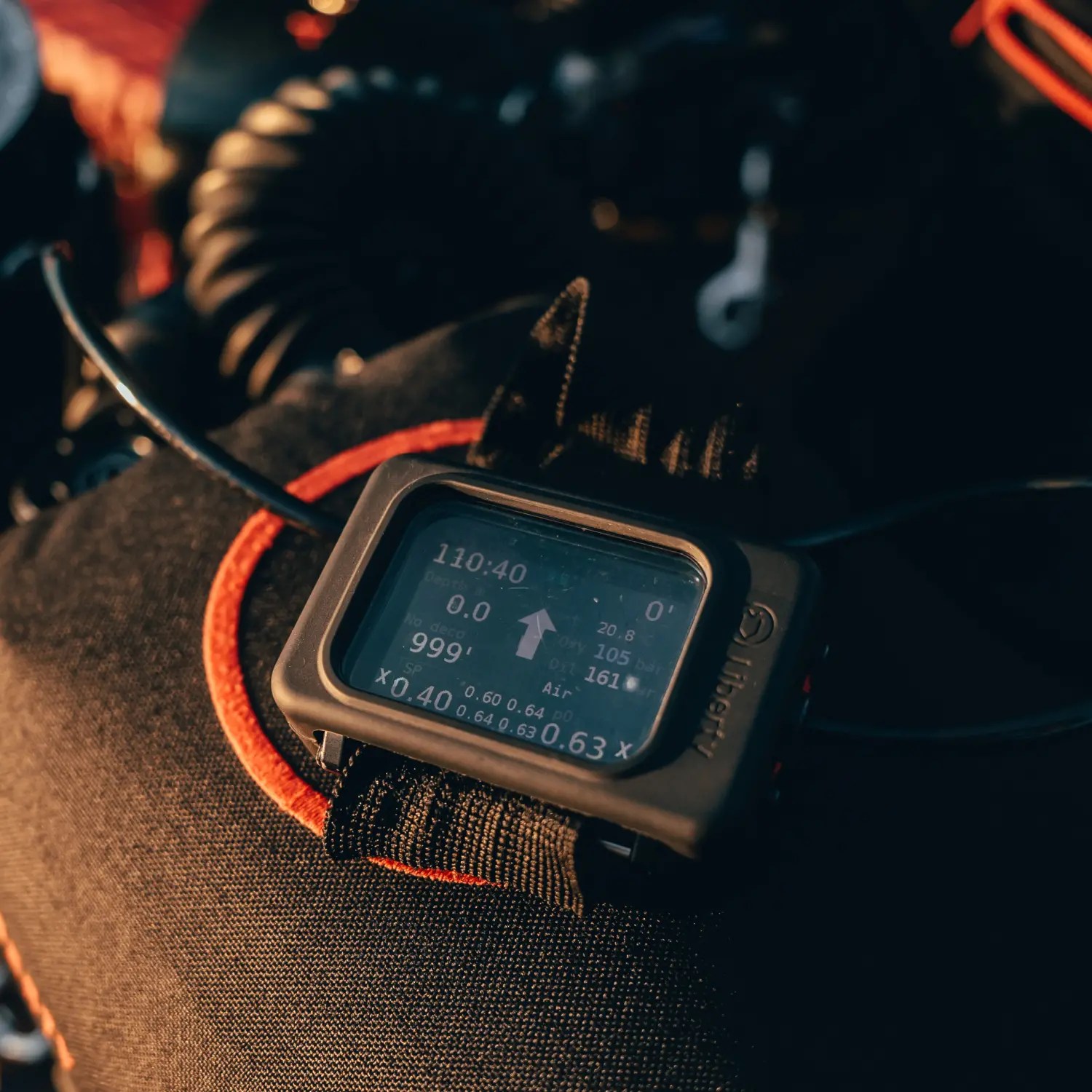
| Handsets | 2 | Two independent displays for critical dive information. |
| HUD | Independent visual monitoring | Immediate status awareness without looking at a handset. |
| Buddy Display | External status indication | Allows teammates to verify the diver's system status. |
Each component serves a specific purpose. Together, they create a system where no single failure automatically becomes a dive-ending emergency. The goal is not to make the unit more complicated. The goal is to prevent a small problem from becoming a large one.
What Happens When Something Goes Wrong?
This is where redundancy proves its value. A truly fault-tolerant system is not defined by the absence of failures.
It is defined by what happens after a failure occurs. When Liberty detects a problem, the diver is immediately informed.
The information is clear, actionable, and designed to support decision-making under stress.
Most importantly, the diver typically has multiple response options available.
Rather than creating a situation where a single component failure immediately escalates into a critical emergency, Liberty's architecture helps preserve control and buy time.
Time to think.
Time to verify.
Time to execute the appropriate procedure.
That is one of the most important benefits of redundancy.
Depth Ratings and Pressure Testing
Depth ratings are often misunderstood.
The Liberty CCR is depth-limited to 170 meters in its standard configuration due to regulator limitations.
However, the unit's other components have been pressure-tested significantly deeper.
Certain components have undergone pressure testing equivalent to approximately 600 meters of depth. Of course, this does not imply that divers should attempt such depths.
Training, experience, environmental conditions, team procedures, and operational objectives always determine appropriate dive limits.
What these figures demonstrate is engineering margin. And engineering margin is another form of redundancy.
Work of Breathing: Why It Matters More Than You Think
As dives become deeper and longer, work of breathing (WOB) becomes increasingly important.
Higher breathing resistance can increase diver workload and contribute to carbon dioxide retention. Over extended technical dives, even small differences become significant.
This is why professional divers pay close attention to WOB figures when evaluating a CCR platform.
A breathing system that remains comfortable and efficient over hours of diving helps reduce fatigue and maintain performance throughout the dive.
When depth, time, and decompression obligations increase, breathing efficiency is no longer just a comfort feature. It becomes part of the overall safety equation.
Expedition Reality: Complexity That Reduces Downtime
Expedition divers often operate far from service centers, replacement parts, and logistical support.
In these environments, serviceability matters.
Imagine a remote expedition where a component develops a fault.
With a modular architecture, the affected component can often be isolated, inspected, serviced, or replaced without removing the entire system from operation.
This is another example of how engineering complexity can actually simplify operations.
The goal is not to create more components.
The goal is to avoid situations where one component takes an entire expedition offline.
Overengineering Isn't a Luxury
At first glance, Liberty's architecture may appear more complex than some alternatives.
But complexity alone is the wrong metric.
The real question is whether that complexity creates additional workload for the diver.
In Liberty's case, it does the opposite.
Its additional sensors, controllers, monitoring pathways, and backup systems exist to reduce uncertainty and maintain control when the stakes are highest.
The diver is not expected to manage all those systems. The system manages itself.
The diver monitors PPO₂, follows established procedures, and focuses on the mission.
That is the paradox at the heart of Liberty's design: The more sophisticated the engineering becomes behind the scenes, the simpler and more predictable the diving experience becomes.
Redundancy is not there to make diving more complicated. It is there to prevent complications.
And when dives are measured in hours rather than minutes, and in hundreds rather than tens of meters, that distinction matters.
READ MORE:
Download the Professional CCR Comparison Checklist
Choosing a CCR is one of the most important equipment decisions a technical diver will make.
Before comparing prices, compare architectures.
Ask questions about:
- Redundancy
- Oxygen monitoring
- Fault detection
- Backup procedures
- Serviceability
- Work of breathing
- Depth capability
Download our Professional CCR Comparison Checklist and evaluate which system best matches your diving objectives. Or explore the full Liberty CCR technical specifications to see how its engineering philosophy translates into real-world performance.
Author: Jakub Šimánek
Divesoft.app
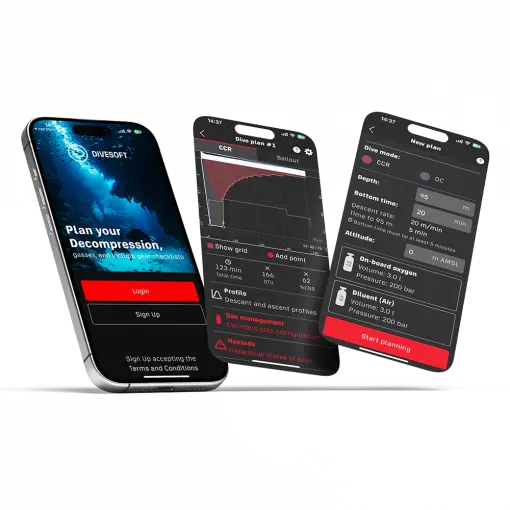
Plan your decompression, gasses, utilize checklists, check your logs + more!!
All for Free.